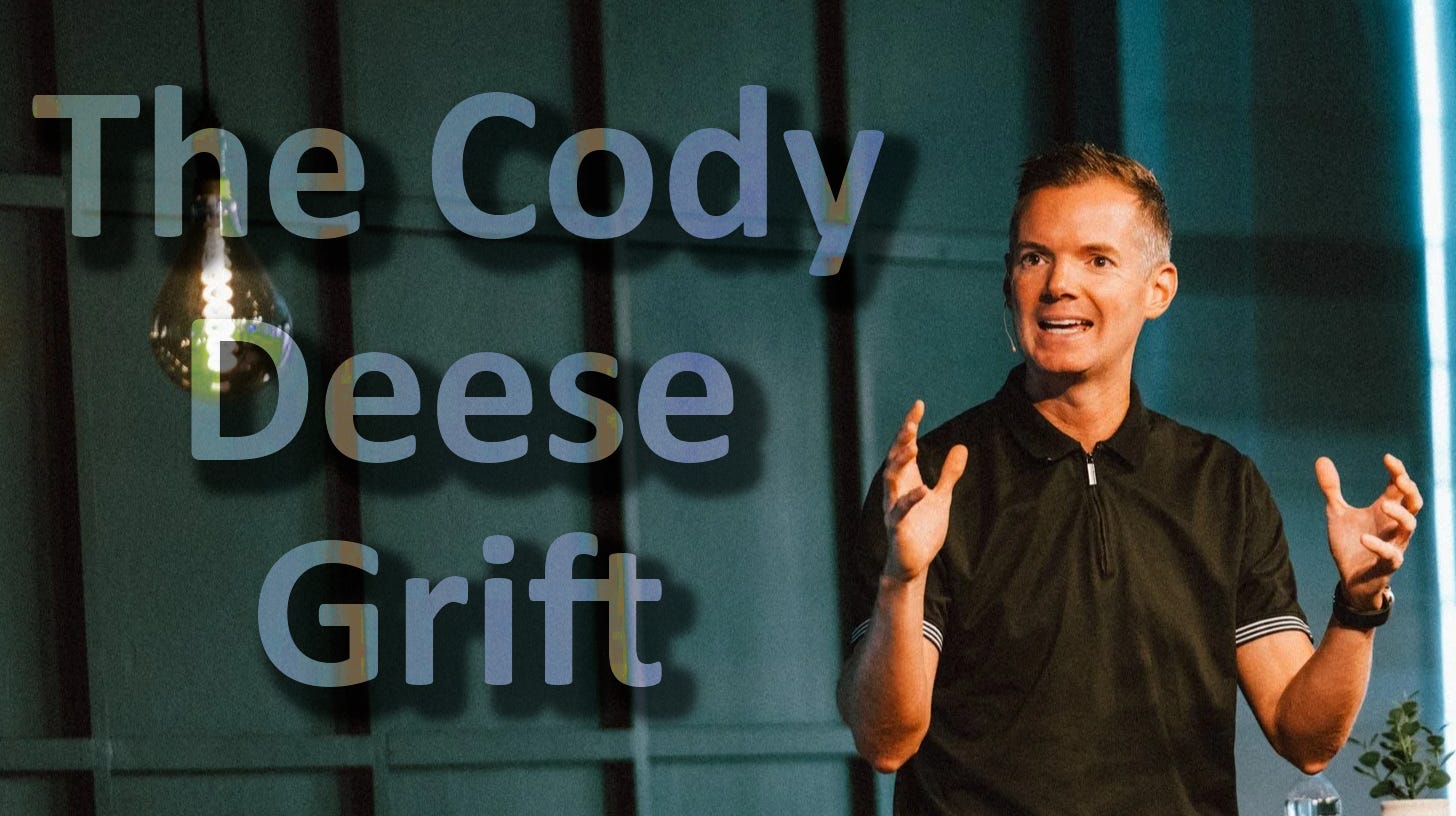
The Cody Deese Grift
Why Late-Stage Christian Gospel is Deplorable

There is a quiet crisis unfolding inside of Christianity. It has nothing to do with sin or salvation. It has nothing to do with scripture. It has everything to do with the algorithm.
Short-form video platforms like Instagram and TikTok don’t care about your denomination or your doctrines. They care about engagement. Engagement, as it turns out, gravitates toward whatever type of content keeps your eyeballs on the screen. If a curious young person wanders into a certain corner on these platforms, they can easily find themselves dining for hours on a buffet of religious polemics.
The appetizer might be Alex O’Connor dissecting cosmological arguments with surgical precision, or it could be Richard Dawkins dismissing the God hypothesis altogether with his special brand of dressed-up academic contempt. The main course would likely be an oversized helping of Christopher Hitchens eviscerating religious apologists, casting out perfectly crafted verdicts with a glass of scotch in one hand and a cigarette in the other.
Back to the buffet for another plate, they’ll find Dan McClellan, a legitimate biblical scholar who will cheerfully dismantle scriptural literalism from the inside. If they’re lucky enough to have saved room for dessert, they might be treated to a few clips of George Carlin systematically dismantling The Ten Commandments. This torrent of reason is a force that organized religion has never had to reckon with at this scale.
Reason is exactly what unites these great thinkers. Atheism is just the inevitable side effect. For the church, there’s no looming threat that young people will become immoral or that society will collapse. The threat is that the tools needed for examining religion critically are, for the first time in history, more accessible than a Sunday sermon could ever hope to be. You no longer need a library card or a degree in philosophy. You just need an iPhone and a Sunday afternoon.
When your business is to sell mythology, you’ve really got your work cut out for you.
Enter Cody Deese.
Son of a Preacher Man
Deese was not built for an ordinary church. He was built for right now, and that distinction matters enormously.
He grew up the son of a Southern Baptist pastor, and he absorbed the vocabulary, rhythm, and emotional architecture of evangelical Christianity before he was old enough to question any of it. He delivered his first sermon at sixteen. Later, he earned his MDiv (Master of Divinity) from Emory University’s Candler School of Theology, which is one of the more academically rigorous seminaries in the country. It’s a place where students are genuinely expected to grapple with real historicity, textual contradiction, and the scholarly consensus that all scripture is of human origin. He was not trained in a bubble. He was trained in exactly the kind of institution that produces pastors who know what the critics know and know it well.
This is not a trivial detail. It establishes, from the outset, that what Cody Deese does, he does with full awareness. He is not a man that has never heard the arguments against the product he’s shilling. He sat in classrooms where those arguments were made by serious scholars. Therefore, what follows is not any kind of criticism of his ignorance. It’s an accusation.
In 2006, Deese agreed to help a friend launch Vinings Lake, which was, at the time, a modest Southern Baptist church in the suburbs of Atlanta. The congregation grew, and by 2015, when Deese took over as lead pastor, Vinings Lake had swelled to roughly 700 members and it had a budget to match. It was a success.
Then came what his admirers charitably described as an “evolution.”
By the end of Trump’s first term, Deese had completely reoriented. The church was welcoming to the LGBTQ community, and it was sharply (and conveniently) critical of nationalism and capitalism. It seemed to become self-aware, and sermons became increasingly skeptical of the faith that it preached. Progressive? Over 500 cut ties with the church over this radical turn, and its budget was cut by a million dollars. Soon, there were roughly 100 members who remained. Staff were released from their posts. It was a bloodbath.
Deese’s response to the exodus was radical. He made himself a martyr and rebranded.
In 2021, Vinings Lake officially stopped calling itself a church all together. It became, in its own language, “an ever-evolving spiritual collective.” If you’re a Christian, says the website, wonderful. If you’re post-Christian (yes, that’s a thing…), wonderful. No doctrine is required. No conversion is sought. The community exists, seemingly, just for the sake of it. It’s a gathering of the spiritually homeless, presided over by a man with a master’s degree in theology, a book deal, a side organization called Atlanta Becoming, and a very active social media presence.
Somewhere in that trajectory from Southern Baptist pastor’s son to leader of a self-described “empire-subverting spiritual collective”, Cody Deese made a decision. He was going to steal the critics’ language and sell it back to the people the critics were trying to reach.
The Stand-Up Pastor
What makes Deese genuinely dangerous to dismiss is that he is, by most accounts, extraordinarily compelling on the microphone. He oozes charisma. He delivers his sermons like a stand-up comedian. He’s loose and conversational. He’s a disarming speaker who can float a radical theological idea and have the room smiling before anyone thinks to push back. This is not a minor skill. It is, in the context of his grift, fully weaponized.
The comparison to stand-up is not incidental. Good stand-up works by building trust through laughter, then using that trust to smuggle in a little truth (or something that feels true) over the audience’s defenses while they’re still disarmed. Deese operates with the same mechanic. His congregation does not feel preached at. They feel understood, recognized, and welcomed into the inside joke of a Christianity that finally admits what everyone already suspected.
This is the product. The charisma is not incidental to the grift. The charisma is the grift.
Stolen Goods
Now, it’s time to make the accusation, both plain and clear. Cody Deese has listened to the critics. He has absorbed all that Hitchens, Dawkins, and O’Connor have to offer, and he understands the cultural pressure and the existential threat they represent. What he’s done with it is not only remarkable, but also reprehensible. He’s laundered their arguments through some kind of Christian cheese cloth and sold what was left to his congregation.
This is not speculation. It’s clear in the language he uses, across multiple contexts, in patterns too consistent to be coincidental.
Blood Sacrifice and Atonement
Penal substitution atonement theory is what the scholars call it, but for the regular Joe, it’s just a fancy way of saying that Jesus died for our sins. Deese and his community reject it altogether as ancient “temple language” and it’s the crown jewel of his progressive theology. A common bit in his sermons is to ask the congregation what Jesus’ death actually means. Christopher Hitchens made this exact argument, but it wasn’t as a theological invitation for discourse. It was a refutation. The idea that an omnipotent God required the torture and execution of his own son in order to forgive creatures he himself designed is primitive religious transaction dressed up in a language of love. Stephen Fry called it “monstrous.” Deese agrees with both of them. He simply repackages the conclusion as spiritual invitation, collects the tithes, and moves on.
Religious Trauma
Deese will talk about religious trauma liberally in his sermons. The idea is that other Christian churches might subscribe too closely to the doctrines, and the result is trauma for members of those congregations. It’s practically a prerequisite for membership. But “religious trauma” is not some kind of theological concept at all. It’s a clinical and secular one, developed and popularized largely outside the church by psychologists and former believers who were documenting the psychological harm caused by authoritarian religion. Hitchens said that religion harms children. It harms adults. It damages minds. It was atheist critics who built the evidentiary case for religious trauma as a real and serious phenomenon. Deese has taken that framework, stripped it of the very clear implication that religion itself is the problem, and redeployed it as a piece of marketing copy. Come to us, it says. We’re the church that knows where the bad church touched you.
Religion and Empire
One of the most revealing pieces of language in Deese’s ecosystem is the description of Vinings Lake as a “system confronting, empire subverting community.” The idea that Christianity has historically functioned as a tool of the empire, for conquest and political control is a staple of secular historical criticism. Hitchens dedicated substantial portions of his book God Is Not Great to documenting the marriage of religious authority and colonial violence. It is not a theological argument that emerged from Christianity. It is a criticism that was leveled against Christianity by its detractors. Deese has absorbed it entirely, and then in a move of remarkable audacity, repurposed it as his church’s identity. It was the critics that said religion serves the empire. Deese says it’s all the other Christian churches that serve the empire, and his somehow subverts it. The argument that immunizes him against that criticism is just a stolen and domesticated version of the argument itself.
Certainty and Questions
Vinings Lake’s communities are explicitly described as spaces that “prefer questions over answers” and reject doctrinal prescriptions. The epistemological criticism of organized religion is that it claims certainty when there is none and punishes those who doubt it. It demands complete intellectual surrender. It’s probably the oldest and most effective argument in the secular toolkit. O’Connor, Dawkins, and Hitchens all return to it repeatedly. The argument is that religion is not just wrong but is structured in such a way in which it resists exposure, because doubt is treated as sin. Deese, miraculously, concedes the entire point. His community openly agrees that certainty is dangerous, answers should be treated as suspect, and questions are more honest than any doctrine could ever hope to be. What he’s actually done is simply refuse to follow that concession to its logical conclusion. He won’t do that because admission of the conclusion would cause him to have to stop conducting services and earning tax-free dollars for spiritual guidance. Instead, he’s built a community whose founding principle is the secular criticism of religion itself, which he, ironically leads as a pastor.
Jesus Christ
Vinings Lake officially views Jesus as “a model for spiritual living” rather than a supernatural redeemer. This is not a theological innovation. It is secular humanism with a cross on the logo. The argument that Jesus of Nazareth, divested of the supernatural machinery built around him by Paul, might be admired as just a symbol of morality, is a position held by people who have already concluded, or strongly suspect, that the resurrection did not happen. Thomas Jefferson made this claim. Bertrand Russell played with it. It is the position you arrive at when you want to keep the aesthetics of Christianity while discarding the metaphysics. Deese has built an entire community around that position while maintaining all the institutional bullshit. You know, his pastoral role, the congregation, the book deal, etc.
Hijacked Religion
Deese has recently emerged as a prominent voice on what he calls “hijacked Christianity.” This is the idea that the MAGA movement and Christian nationalists have co-opted religion for their own benefit. Whether that’s true or not doesn’t matter. The point is that this is another secular argument. Hitchens and Dawkins spent their entire careers documenting how religious authority is exploited by the powerful to manufacture consent, suppress dissent, and cloak political violence in moral language. Deese deploys the same framework, and then, in a move that defines his entire operation, uses it to position himself as the corrective force. His Christianity hasn’t been hijacked. His Christianity is the real thing, right? He’s saying that the very thing used to justify colonialism and slavery and MAGA is fake. His Christianity is the real thing. This is, to put it plainly, unfalsifiable. And unfalsifiability, in the hands of someone who has a financial interest in the conclusion, is the oldest grift in the book.
Evangelism
Vinings Lake explicitly has “no intention of converting anybody to anything.” This is worth pausing on. What about The Great Commission? “Go and make disciples of all nations” is not a footnote in Christian theology. It is one of the last things Jesus says before the ascension. It is the mandate from which two thousand years of missionary activity, however brutal, absolves itself. To abandon it is not a progressive refinement of the faith. It is a silent concession of one of the faith’s most foundational obligations. The secular and atheist critique of evangelism is that it is inherently coercive. It’s the organized imposition of one group’s unfounded beliefs on people who never asked for them. Deese has accepted that critique without acknowledgment. He has never, to anyone’s knowledge, stood before his congregation and explained that he has effectively dismissed a direct instruction from the figure his entire enterprise is built around. He just stopped doing it, pocketed the progressive credibility (and money), and moved on.
The pattern across all of these is the same, really. Deese takes the conclusion of the secular critique, strips away the implications that could end his career, and presents the remainder as spiritual wisdom. What’s left, every time, is a Christianity that has been evacuated of its distinguishing claims.
The Name on the Door
“Christianity” is named after Christ. “Christ” is not Jesus’s last name. It is a title. The anointed one. The specific theological content of that title, in the tradition Deese was ordained to represent, is not ambiguous. It refers to the one who was sent to suffer, die for the sins of humanity, and rise again. The death is not incidental to the title. The death is the title.
And then there’s the cross itself. This Roman instrument of execution hangs in every church, is printed on every Bible, and it worn around every Christian neck. It’s not just some decorative motif. It’s the central symbol of the faith itself. It’s not just some logo. It’s a confession. It’s the entire argument, compressed into a single image.
Sin, grace, redemption, salvation, and the incarnation itself represent the entire theological architecture of Christianity, and it’s all based around the necessity of Jesus’ death! God became human so that he could die. It’s not one claim among many. It is the claim from which all the others derive meaning. Remove it, and what remains is not a simpler Christianity. What remains is not Christianity at all. It is, at best, a philosophy club with good acoustics and a nice parking lot.
Deese does not merely downplay this. He has, in practice, removed it entirely. His community does not center around the resurrection of Christ, and he doesn’t give two shits about humanity’s redemption arc. It centers around the “teachings” and the “model” of Jesus, who he presents as a savior, or a rabbi, or a metaphor, or whatever else suits the sermon itself and the desired outcome. Compelling TikTok videos are born out of this nonsense. There is no confession here. There is no cross in any matters that matters. It’s just a sack of charisma delivering easily digestible one-liners where a real church used to stand. He’s carefully removed every load-bearing wall of the faith while leaving the roof in place so that he can charge admission to stand under it.
Deese was not raised outside of this tradition. He was raised inside of it, by a man who preached it. He earned a graduate degree in it. While his congregation might not understand what he’s doing, he certainly does. He knows that “Christ” is not a brand name. He knows that the cross is not a vibe. He has perfectly calculated that his audience either doesn’t know this or doesn’t want to be reminded of it, and that there is a great deal of money and influence available to the man who can hold the aesthetics of Christianity together after the theology has been quietly removed.
This is not progressive Christianity. This is the term “Christian” being used as a costume, to sell something else entirely, by someone who knows better.
Rob Bell
It is worth pausing here to note that Cody Deese co-authored his most recent book, Discovering Your Internal Universe, with Rob Bell.
If you know who Rob Bell is, you’ll understand immediately what this means. For the uninitiated, Rob Bell is the original cool pastor. A full decade before Deese, he pioneered the template of the charismatic, progressive pastor who deconstructs evangelical orthodoxy from the inside, loses half his congregation, rebrands as a broadly spiritual figure, and builds a second career selling self-help content to the spiritually lost. His 2011 book Love Wins, rejects the traditional doctrine of eternal hell, and he was subsequently labeled a heretic and effectively expelled from mainstream evangelicalism. In response, he became a podcast host, a wellness speaker on the snake-oil circuit, and a purveyor of the same kind of content Oprah would have been happy to pedal twenty years ago for a cut of the sales.
Deese has not merely followed Bell’s trajectory. He has co-authored a book with him. This is not an association that happens accidentally. It is a deliberate alignment with the most successful previous iteration of the model Deese is now running. It is also, for anyone trying to trace the genealogy of this particular brand of spiritual entrepreneurship, an extraordinarily revealing data point. The playbook is not new. Deese is a second-generation operator.
The Trick
Let’s be precise about the accusation, because precision matters here.
None of what’s written here is aimed at making his congregation look foolish. Vinings Lake may indeed provide genuine comfort and belonging to people who really need it. The accusation, in plain terms, is that Cody Deese is a dishonest charlatan, profiting greatly from the naivety of others.
Deese has built an entire business upon a lie. He has a book deal, a side organization, a speaking platform, and a pastoral salary and its entire value proposition rests upon occupying a specific position in the market for meaning. Specifically, a brand of Christianity that has absorbed and exploited the secular critique. He sells the feeling of being sophisticated enough to have moved past the embarrassing parts of the faith, while keeping enough of the vocabulary and ritual to avoid the existential vertigo of having left it entirely.
To maintain that position, he must continuously perform the same trick. He takes the critic’s conclusions, strips them of their logical implications, and retails them as spiritual depth. The critics say blood sacrifice is barbaric. Deese agrees and invites you to come explore what atonement “really means.” The critics say religion causes trauma. Deese agrees and invites you to a community that “holds space” for your pain. The critics say religion has always served empire. Deese agrees and invites you to join his empire-subverting collective. The critics say dogmatic certainty is epistemically dishonest. Deese agrees and invites you to a community that prefers questions.
But notice what never happens. He never suggests that perhaps, there is no God. He never suggests that perhaps this book we’ve been reading for two thousand years might just be a book. He never follows the arguments where they lead, because following them where they lead would end the business.
That is the grift. It is the careful, practiced, charismatic act of walking his congregation to the edge of a cliff just to stop short of it, every week, while maintaining the posture of a man who has no idea there is a cliff there at all.
When your business is to sell mythology, you have to adapt. You learn the language of the people who are threatening to put you out of business. You hire their vocabulary and fire their conclusions. You become, in the process, not one thing or the other. Not honest enough to be an atheist and not sincere enough to be a believer.
You become Cody Deese.
Personally I'm a huge fan of his work.